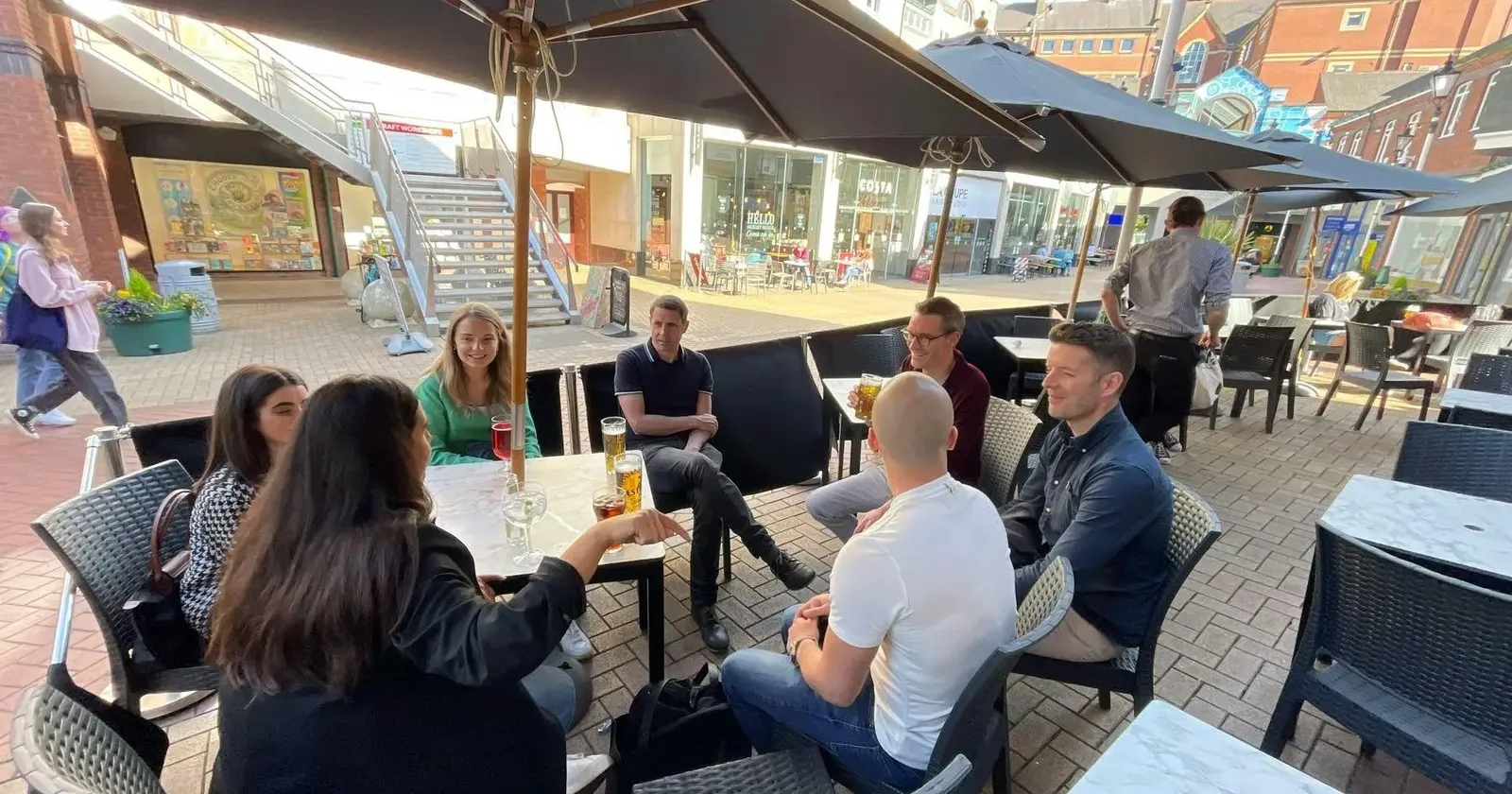


The trick is to treat the session like a good meeting with a game in the middle, not a game with a meeting bolted on. Below you’ll find a test for spotting cringe before you book it, a half-day agenda, twelve ideas grouped by type, the options for small and remote leadership teams, and honest costs.
One thing first. If what you want is leadership development (how the team makes decisions, handles conflict or gives feedback), that’s work for a facilitator or an L&D consultancy, and it’s measured in days. A half-day like this one builds goodwill and gives you a better conversation afterwards. It won’t rewire how a team operates, and nobody should sell it to you as if it will.
The cringe test
Run any idea past these questions before you book it. If the answer to any of them is yes, swap it.
- Does anyone have to share something personal in front of the room?
- Does anyone have to perform alone? Solo role play, a talent spot, a forfeit.
- Is there dressing up that isn’t optional?
- Was it obviously designed for children or a stag do?
- Does a facilitator spell out “the lesson” at the end? Senior people can work out the point themselves.
- Would people avoid it on a Friday afternoon if it weren’t a work event?
The last one is the useful one. Leaders will happily solve a hard puzzle, argue over a verdict or out-trade a rival team. They won’t enjoy being told to hold hands.
A half-day agenda
Four hours is enough. Start with lunch, so people arrive in a good mood and you’re not eating into the morning’s diaries.
| Time | What happens | Why |
|---|---|---|
| 12:30 | Lunch together | Easy start, and people catch up before anything formal |
| 13:15 | Five minutes on why you’re here | One clear purpose, no motivational speaker |
| 13:20 | A short opener (ideas 9 or 10) | Gets the room talking about work, not feelings |
| 13:45 | The main activity (idea 2 or 4) | 90 minutes of something absorbing |
| 15:15 | Break | Let the leaderboard banter happen |
| 15:30 | A debrief about work, not the game | Three questions, 45 minutes (see below) |
| 16:15 | Agree one thing you’ll do differently | Write it down and name an owner |
| 16:30 | Finish, or move to dinner | Dinner optional |
Want a longer activity? Trading Table, The Insiders: Indoor Edition and GPS challenges need two hours. Start the main activity at 13:15, move the welcome to lunch and skip the opener. Or keep the opener and move everything after the activity back by 30 minutes, finishing at 17:00. A cookery class can take three hours, so book that as its own afternoon.
The debrief questions. Keep them about work. What did we do well as a group in the last hour that we don’t do in leadership meetings? Where did we talk over each other or go quiet? What’s one decision we’ve been putting off that we could make with the same energy? Then stop. You don’t need flipcharts about “what the game taught us”.
Strategy and thinking games (60 to 120 minutes)
1. A trading simulation
Teams buy and sell in a live market, negotiate with rival teams and react as prices change. It rewards commercial sense, quick decisions and talking to each other under pressure, which is exactly what a leadership team is supposed to be good at. Senior teams usually take it far more seriously than they expected to.
Duration: 90 to 120 minutes. Group size: 18 and up, in teams of 4 to 6.
2. Invent and pitch a product
Teams create a product, design how they’d sell it and pitch it to the room, who vote for the winner. Everyone’s skills get used, from finance to marketing, and the pitches are where the fun is.
Duration: 90 minutes. Group size: 8 and up, in teams of 4 to 6.
3. A hidden-identity game
One team’s been secretly briefed to work against everyone else, and the rest have to work out who it is before the end. It’s all about reading the room, managing trust and holding your nerve, and a leadership team will be talking about the final reveal for weeks. If you’ve watched The Traitors, you know how it feels.
Duration: 90 to 120 minutes. Group size: 12 and up.
4. An escape game
Teams work through a chain of locked puzzles against the clock. It’s quiet, absorbing and shows very quickly who spots patterns, who checks detail and who keeps everyone moving. It works brilliantly for small or more reserved leadership teams.
Duration: 60 to 90 minutes. Group size: 5 and up, in teams of 4 to 6.
5. The verdict
Teams review a fictional case file, weigh the evidence and agree a verdict. It’s a debate with a clock on it, and it’s a fair rehearsal for how the team makes decisions together.
Duration: 45 minutes. Group size: 5 and up, in teams of 4 to 6.
Out of the room (90 minutes to half a day)
6. A city challenge
Teams head out with a route of GPS checkpoints, trivia and photo tasks, then come back for the results. It gets a leadership team out of the boardroom and walking side by side, which is when the better conversations happen.
Duration: 2 hours. Group size: 8 and up, in teams of 4 to 6.
7. A cookery class or chef’s table
Book a class where the team cooks together and then eats what they’ve made. It’s sociable and practical, and nobody’s being tested on their day job. Book well ahead and check dietary needs first.
Duration: 2 to 3 hours. Group size: usually 6 to 20, depending on the venue.
8. Walking strategy sessions
Split into pairs, give each pair one strategic question and send them on a 30-minute walk. Each pair comes back with one recommendation. It’s free, it’s real work, and it’s often more honest than the same conversation round a table.
Duration: 30 to 45 minutes. Group size: any, in pairs.
Openers that aren’t icebreakers (15 to 25 minutes)
9. The pre-mortem
Ask everyone to imagine it’s a year from now and this year’s plan has failed. Each person writes down the most likely reason, then the group reads them out. It’s a business exercise, not a team building one, and it gets the honest conversation going quickly.
Duration: 20 to 25 minutes. Group size: 4 to 15.
10. How to work with me
Before the day, each leader writes five lines: how they like to receive bad news, when they do their best thinking, what wastes their time. Read them round the table. It’s about work, not personal life, and people refer back to them for months.
Duration: 15 to 20 minutes. Group size: 4 to 15.
No-cringe options if your leadership team is remote
Virtual team building has a reputation for forced fun, mostly because of two-hour quizzes and “show us your pet” rounds. The formats that avoid that have the same things in common as the in-person ones: a real problem, small teams and a clear finish.
11. Online escape or mystery games
Teams of four to six work in breakout rooms on the same puzzles or the same murder case, with one leaderboard. It’s absorbing enough that cameras stay on.
Duration: 60 to 90 minutes. Group size: 5 and up.
12. An online verdict or hidden-identity game
The jury and hidden-identity formats above both work over a video call. They’re built on discussion and strategy rather than performance, which is what makes them work for senior people.
Duration: 45 to 90 minutes. Group size: 5 and up for jury games, 12 and up for hidden identity.
Ideas 2, 9 and 10 also work online, in breakout rooms.
Small leadership teams
Many leadership teams are six to ten people, which rules out some formats. Escape games, jury games and murder mysteries start at five players. Most treasure hunts and challenge games start at eight. Trading and hidden-identity games need a bigger group, so save those for a wider senior team or a leadership conference.
Run it for you
If you’d rather not write the puzzles and run the clock yourself, our hosted team building activities cover every idea in the first and last sections. A host runs the briefing, the scoring and the results, so you can play with your team instead of organising them. Everyone plays on their phones in our Mobile Adventures app.
In person, the ones that suit leadership teams best are Trading Table: The Smoothie Hustle (two hours, 18 or more, with an Onsite Host), The Pitch (90 minutes), The Insiders: Indoor Edition (two hours, 12 or more), Escape: Arctic Survival (60 or 90 minutes, from 5 players) and GPS challenges like Spy School: In The Field (two hours).
Online, try The Insiders: Virtual Edition (90 minutes, 12 or more), Jury Service: MacLean House Jewellery Heist (45 minutes, from 5), Escape: Art Heist (60 or 90 minutes) and Murder on the Train (90 minutes). The Pitch runs online and hybrid too.
What does it cost?
The pre-mortem, the “how to work with me” round and walking strategy sessions are free. Cookery classes are priced by the venue.
Most of our hosted activities are £12 per person + VAT, plus £250 + VAT for a Remote Host or £750 + VAT for an Onsite Host, with one host for every 50 people. Bookings with an Onsite Host have a £1,500 + VAT minimum spend. GPS challenges are £15 per person + VAT. The Jury Service games include the host and carry a £240 + VAT minimum instead. Trading Table is priced differently, with its own Onsite Host fee and minimum, and its page shows the full price for your numbers. As a worked example, a 10-person leadership team on Escape: Arctic Survival with a Remote Host pays 10 x £12 = £120, plus £250, so £370 + VAT. Venue, food and travel aren’t included.
Are there free options?
Yes. The pre-mortem, “how to work with me” and walking strategy sessions cost nothing, and together they’d fill a useful afternoon on their own. DIY escape games and quizzes are free too, but writing a good one takes hours, and someone on the leadership team ends up running it instead of playing.
Which platforms does it work on?
The in-person ideas work in any meeting room, office or venue, and the GPS challenges in any town or city. The online games run over Zoom, Microsoft Teams, Google Meet or any video platform you already use. For our hosted games, each player needs a smartphone or tablet with a working connection.
FAQs
Our leadership team needs a half-day team building session that doesn’t feel cheesy. What would you suggest?
Build the half-day around one absorbing, strategic activity, like a trading simulation, a product pitch, a hidden-identity game or an escape game, then follow it with a short debrief about how the team works. Start with lunch, skip personal-sharing icebreakers and don’t spell out the lesson.
What are the best virtual team building activities for companies that don’t want cringe games?
Ones built on a real problem in small teams: online escape games, murder mysteries, jury games where teams agree a verdict, and hidden-identity games like The Insiders. Avoid long quizzes, personal show-and-tell rounds and anything that asks people to perform alone on camera.
How do you make leadership team building not cringe?
Choose activities people would do voluntarily, keep them competitive and adult, put people in small teams, never make anyone perform alone and keep the debrief about work. If an idea fails any of those, swap it.
What’s a good team building activity for a small leadership team?
For six to ten people, an escape game, a jury game or a murder mystery, all of which start at five players. A pre-mortem or a walking strategy session works for any size and costs nothing.
Can a half-day of team building develop a leadership team?
It can build goodwill and lead to a better conversation, but it won’t change how a team makes decisions or handles conflict. For that, hire a facilitator or an L&D consultancy.
How much does a leadership team building half-day cost?
The DIY ideas are free. Hosted Wildgoose activities are mostly £12 per person + VAT, plus £250 + VAT for a Remote Host. For a 10-person team on an escape game, that’s £370 + VAT. Venue and food are extra.