


The good news is that a remote team’s first meetup isn’t starting from zero. People already know how each other work. What they don’t know is how each other are: how tall, how loud, whether they’re a morning person, what they’re like when they’re not on mute. The day’s job is to fill that gap, and the best way to do that is to give people something to do together rather than something to talk about.
Below you’ll find a timed agenda, twelve activities grouped by how long they take, two teams who’ve done exactly this, and the honest numbers on cost. Most of it’s free.
This guide is for a team meeting in person for the first time. If your team already shares an office some of the week and you’re planning around the autumn return, our back-to-office team building ideas are a better fit.
What’s different about a first meetup
Four things catch organisers out.
- The first hour is the hardest. People who chat happily on Slack can go quiet in a room. A clear first task does more than any icebreaker speech.
- Everyone’s travelled. Some people will have been up since five. Don’t plan anything demanding before mid-morning, and don’t schedule a late night as compulsory.
- People already have their cliques. The colleagues who talk every day on calls will find each other in seconds. If you want new connections, you have to build the mixing in.
- Not everyone can come. Someone will be ill, on leave or unable to travel. Decide early how they’ll join, so they aren’t an afterthought on the day.
A first-meetup agenda that works
Here’s a one-day plan for 15 to 60 people. Move the times to fit the trains, but keep the shape: short welcome, light opener, one real work session, a long lunch, then the shared activity everyone will talk about afterwards.
| Time | What happens | Why |
|---|---|---|
| 10:30 | Arrival, coffee, name badges | A 30-minute window means nobody walks into silence |
| 11:00 | Ten-minute welcome and the one goal for the day | Tell people what the day’s for, then stop talking |
| 11:10 | A light opener in mixed groups (see 1 to 4 below) | Gives everyone an easy first conversation |
| 11:45 | One working session on something you can’t do on a call | A whiteboard problem, a roadmap or a retro |
| 13:00 | Long lunch on mixed tables | 75 minutes, so people have time to talk |
| 14:15 | The main shared activity (see 9 to 12 below) | The bit people remember |
| 16:30 | Results, photos and thank-yous | A clear end to the day |
| 17:00 | Optional drinks or dinner | Optional means optional, with good alcohol-free drinks |
Got two or three days? Put the shared activity on the first afternoon, not the last. It does its work as an icebreaker, and people spend the rest of the meetup with colleagues they’ve already laughed with. That’s exactly how Oomph used it (more on them below).
First-hour openers (10 to 30 minutes)
1. Badges with a question on them
Print name badges with the name people use at work, their role and one line underneath: “ask me about my worst commute”, “ask me what I’d cook for the team”. It hands everyone a ready-made opening line and needs no organising on the day.
Duration: runs all day. Group size: any.
2. The map wall
Put a big printed map on the wall and ask people to stick a pin where they’ve been working from, then a second colour where they grew up. Within ten minutes, people are finding the colleague who lives two towns away.
Duration: 10 minutes, then left up all day. Group size: any.
3. Silent line-ups
Ask the whole group to line up, without talking, in order of start date, then by distance travelled, then by birthday. It’s quick, gets people moving and nobody has to say anything personal in front of the room.
Duration: 10 to 15 minutes. Group size: 10 to 60.
4. Recreate the screenshot
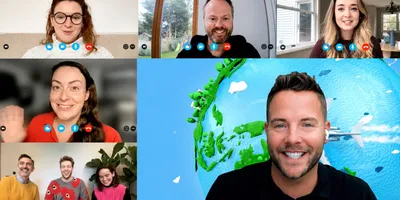
Find a favourite video-call screenshot from the last couple of years and ask the people in it to recreate it in real life for a photo. It’s a gentle in-joke that only a remote team gets, and it makes a good slide for the end of the day. Keep it opt-in.
Duration: 15 to 20 minutes. Group size: any, in groups of 4 to 9.
Activities that get people mixing (30 to 60 minutes)
5. Lunch roulette
Set the lunch tables in advance so each one has a mix of teams, offices and seniority. Put a card on each table with two easy questions on it. It costs nothing and does more mixing than any game.
Duration: lunch. Group size: any, tables of 6 to 8.
6. Walking pairs
Send people out in pairs for a 20-minute walk with one question to answer together (“what’s one thing that’s easier remotely, and one that’s easier face to face?”). Swap the pairs and go again. People find it easier to talk side by side than across a table.
Duration: 20 to 40 minutes. Group size: any, in pairs.
7. The “who said it?” quiz
Pull 15 harmless quotes from your team chat, meeting notes or old all-hands slides and turn them into a quiz. Teams of four to six guess who said each one. It only works for a team with a shared history, which is exactly what yours has.
Duration: 30 to 45 minutes. Group size: 10 to 100, in teams of 4 to 6.
8. A build or problem-solving challenge
Give each mixed team the same kit (paper, tape, card) and the same brief, like the tallest free-standing tower or a bridge that holds a mug. It needs a bit of prep but works in any meeting room, and it shows people how their new teammates think.
Duration: 30 to 45 minutes. Group size: 8 to 60, in teams of 4 to 6.
The main event (90 minutes to half a day)
9. A city treasure hunt
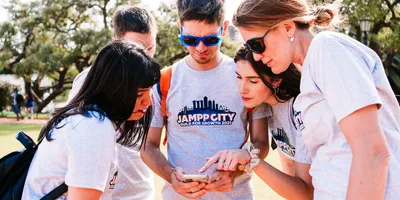
Teams of four to six head out with a route of checkpoints, photo tasks and clues, and race back for the results. It’s the classic choice for a first meetup because people talk while they walk, everyone can find a role, and it shows off the city to anyone who’s travelled in. You can write a paper version yourself or use an app-based hunt with GPS checkpoints and a live leaderboard.
Duration: 2 hours. Group size: 8 to 750, in teams of 4 to 6.
10. Escape rooms
Book several rooms at the same venue at the same time, with mixed teams in each, and compare times at the end. It’s intense and quick, which suits groups who’d rather solve something than chat. Check how many rooms the venue can run at once before you invite 40 people.
Duration: 60 minutes, plus travel. Group size: 2 to 6 per room, so it depends on the venue.
11. A hands-on workshop
A cookery class, a pottery session or a cocktail masterclass. People learn something together, nobody’s being tested and there’s food or a souvenir at the end. Book early, because good venues fill up, and check dietary needs before you choose.
Duration: 2 to 3 hours. Group size: usually 10 to 40, depending on the venue.
12. A team film
Give each team an hour and a phone to make a 60-second film about the team, with a few rules (everyone appears, one line of dialogue each, one prop from the venue). Premiere them over drinks. It’s silly, creative and gives you something to share with whoever couldn’t make it.
Duration: 60 to 90 minutes. Group size: 10 to 60, in teams of 4 to 6.
Two teams who’ve done it
BT, Manchester. BT wanted to bring a team of 18 together for the first time in two years, with some people meeting face to face for the very first time. They ran Spy School: In The Field, a GPS challenge around the city with photo, video and trivia tasks, and kept it to a couple of hours. The team leader’s verdict: “We hadn’t spent time together as a team in 2 years. The team works really hard so I wanted to book something we’d have fun doing. Getting out and about in the fresh air combined with the fun tasks is a brilliant way to spend a couple of hours. A great laugh with a competitive edge! Thank you.” Read the BT case study.
Oomph, Inc., Providence. Oomph’s distributed team met for their first Team Summit in two years, a three-day event. They used Urban Explorer to kick it off, in small teams around a city many of them were visiting for the first time, so the rest of the summit started with people who’d already worked together on something. In their words: “Our distributed team was in-person for the first time in a long time and chose the Urban Explorer scavenger hunt as part of our three-day event. It was AWESOME!” Read the Oomph case study.
How to mix the teams
Random teams aren’t really random, because people swap to sit with friends. Set them yourself, using a few simple rules.
- Teams of four to six. Big enough for a mix of skills, small enough that nobody can hide.
- No more than two people from the same project or office in a team.
- Spread the managers and the loudest voices. One per team at most.
- Pair new starters with long-timers, so nobody’s the only new face in a group.
- Tell people their team the day before. It takes the nerves out of walking into a room of strangers.
What to send people before the day
A one-page email a week before saves a lot of nervous questions on the day.
- The venue address, the arrival window and the nearest station.
- The finish time, so people can book trains home with confidence.
- What to wear, and especially what shoes, if there’s walking. Say roughly how far.
- Whether anything happens outdoors and what you’ll do if it rains.
- Whether people need a charged phone, and whether there’s an app to download.
- Food plans, and a private way to tell you about dietary, access or other needs.
- Who to call if they’re running late.
Including the people who can’t be there
Decide this before you book anything. Two options work well.
- Run a hybrid activity. Choose something the people at home can play over a video call, on the same leaderboard as the people in the room. It’s far better than watching the room on a laptop propped on a chair.
- Bring the day to them afterwards. Share the photos, the films and the results the same evening, and plan the next meetup with them in mind.
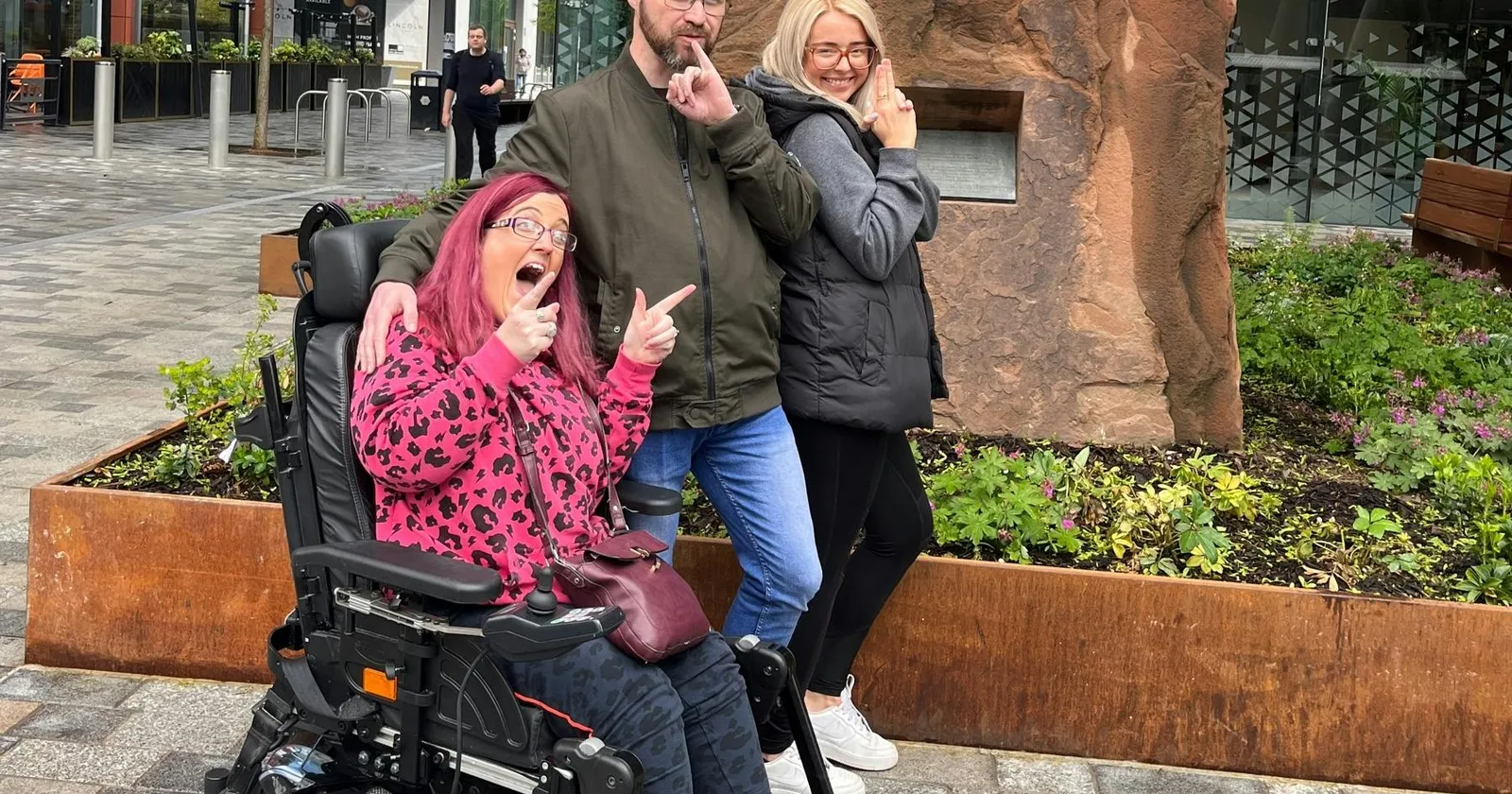
The same thinking applies to anyone who’d rather not walk a long route. On a treasure hunt, a team can play from the venue instead. When the Metropolitan Police ran a GPS challenge for a departmental away day, the organiser said: “It was also great that those who were not able to get out and about could participate as a team from the venue.”
What to skip
- Personal-sharing icebreakers in the first five minutes.
- An agenda packed from breakfast to midnight.
- Surprise physical challenges nobody was warned about.
- A social plan that only works if you drink.
- Games that reward knowing the company’s history, because your newer people won’t.
- Assuming your best talkers on calls want to host the room.
Run it for you
If you’d rather not write a route, mark 20 teams’ photos or stand in the rain with a clipboard, our hosted in-person team building activities are built for this kind of day. A host briefs everyone, keeps the teams moving and runs the results at the end. Everyone plays in teams of 4 to 6 on their phones, in our Mobile Adventures app.
For the main event, our GPS treasure hunts start wherever suits you (your office, your hotel or the venue) and run for two hours, for 8 to 750 people. The Ultimate, Urban Explorer and Spy School: In The Field are the usual picks. If you’d rather stay indoors, Level Up runs for 60 or 90 minutes in a meeting room, and Invigorate is a 30 or 45-minute energiser where every challenge has to be done with a different group of people, which is about as much mixing as you can fit into half an hour. For a whole afternoon, The Insiders: Indoor Edition is a two-hour, Traitors-inspired game for 12 or more, run by an Onsite Host.
Two things that matter for a first meetup. Outdoor events are covered by our wet weather guarantee, so if the forecast turns you can switch to Level Up at no extra cost with 24 hours’ notice, venue permitting. Self-managed bookings are excluded. And custom questions let you add up to eight of your own to the game, which is the easiest way to get the team’s in-jokes into it.
What does it cost?
Everything in the first two activity sections is free, apart from badges, a map and some card. Workshops and escape rooms are priced by the venue.
Our GPS treasure hunts are £15 per person + VAT. Most of our indoor activities are £12 per person + VAT. A host is extra: £250 + VAT for a Remote Host or £750 + VAT for an Onsite Host, with one host for every 50 people. Bookings with an Onsite Host have a £1,500 + VAT minimum spend. A few shorter formats, Invigorate among them, include the host and carry a £240 + VAT minimum instead. Custom questions are £200 + VAT. As a worked example, a 30-person GPS treasure hunt with a Remote Host is 30 x £15 = £450, plus £250, so £700 + VAT. We supply the activity and the app. The venue, food, drink and travel are booked separately.
Are there free options?
Yes, plenty. Badges, the map wall, line-ups, lunch roulette, walking pairs and a “who said it?” quiz cost nothing but a bit of preparation. You can write your own paper treasure hunt too. It’ll take an afternoon to plan and walk the route first, and someone has to mark it on the day.
Where does it work?
Anywhere you can get the team together: your office, a hired meeting room, a hotel or out in a city. Our outdoor hunts run in any UK city or the grounds of your venue. Each player needs a smartphone or tablet with a working connection. For colleagues who can’t travel, our hybrid activities run over Zoom, Microsoft Teams, Google Meet or whatever video platform you already use, with everyone on one leaderboard.
FAQs
Our team has been fully remote for two years. What activities work for a first in-person get-together?
Activities that give people a shared task in small mixed teams, rather than ones that ask them to talk about themselves. A city treasure hunt, an escape room, a “who said it?” quiz built from your team chat or a build challenge all work well. Start with a light opener like silent line-ups, and leave a long lunch for proper conversation.
How long should a first in-person meetup be?
One day is enough for a team of up to about 60. Plan a 10:30 arrival, a short welcome, one working session, a 75-minute lunch, a two-hour shared activity and an optional dinner. For two or three days, put the shared activity on the first afternoon.
How do you make a remote team’s first meetup less awkward?
Give people something to do in the first half hour, set the teams yourself so they mix, tell people their team the day before, and skip personal-sharing icebreakers. Most of the awkwardness goes once people are working on something together.
What’s the best team building activity for a remote team meeting in person for the first time?
For most teams, a two-hour treasure hunt in small mixed teams. People talk while they walk, everyone gets a role and it gives the group a shared story. BT used a GPS challenge for a team meeting for the first time in two years, and Oomph used one to open a three-day summit.
How much does a remote team meetup activity cost?
DIY openers and quizzes are free. A hosted GPS treasure hunt from Wildgoose is £15 per person + VAT, plus £250 + VAT for a Remote Host or £750 + VAT for an Onsite Host (with a £1,500 + VAT minimum spend). For 30 people with a Remote Host, that’s £700 + VAT. Venue, food and travel are extra.
What if some of the team can’t travel?
Choose a hybrid activity so they can play from home over a video call on the same leaderboard. Then share the photos, films and results the same day.